
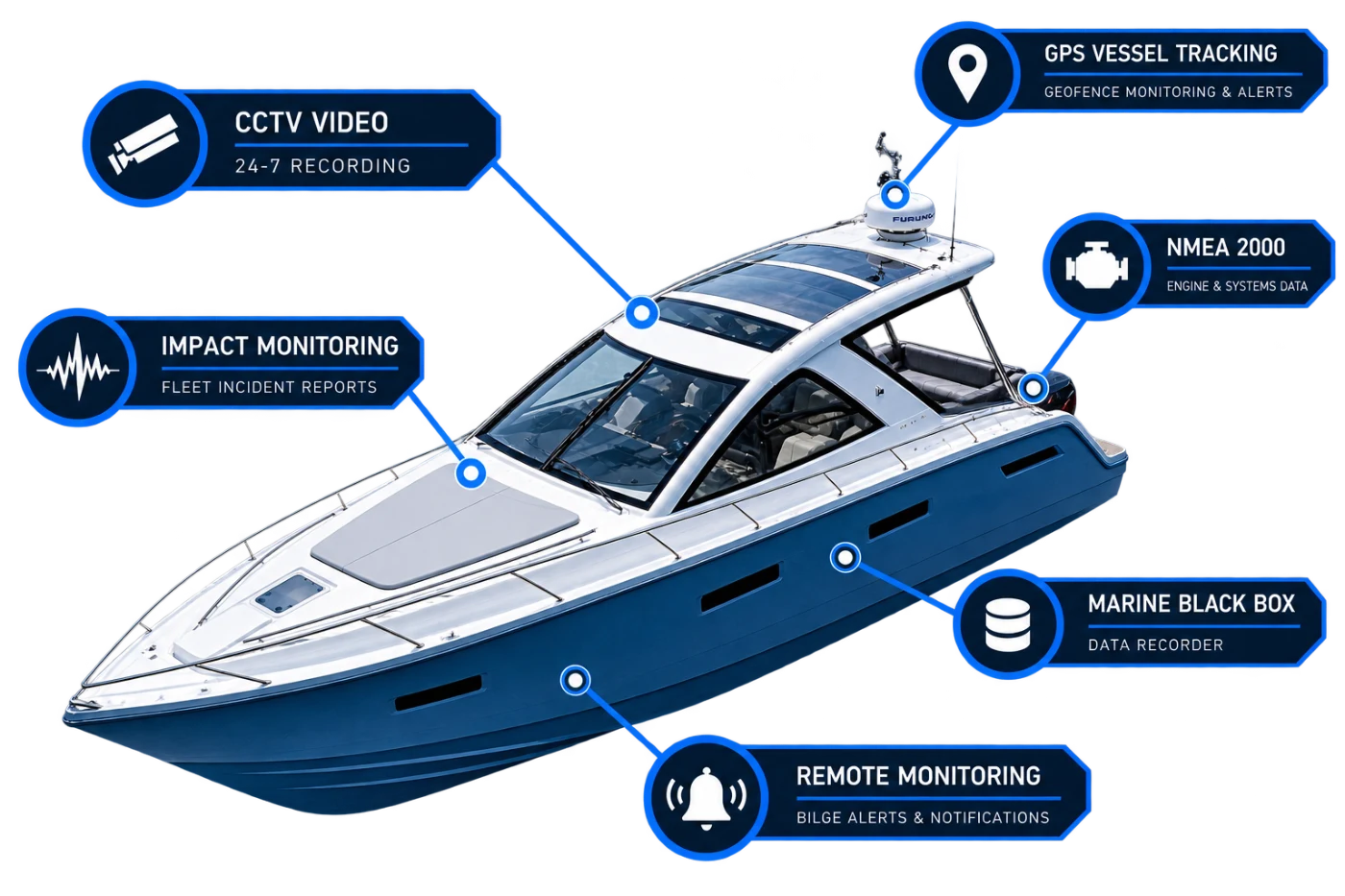
There are now many remote boat monitoring systems on the market, and they differ more than the product pages suggest. Some send a text message when the bilge pump starts. Others connect to the whole boat and stream live video. This guide sets out what to check before you buy, so you can match a system to your boat, your mooring and how often you visit.
Start with what you want to know
Write down the three or four things that would make you drive to the marina. For most owners the list is the same:
- Water. Is the bilge pump running more than usual, and is the water level rising?
- Power. Are the batteries holding voltage, and is shore power still connected?
- Position. Is the boat where you left it?
- Access. Has anyone opened a hatch or door?
Anything beyond this, such as cameras, engine data or tank levels, is useful but should come second to getting these right. Our guide to remote bilge monitoring covers the water side in more detail.
The three main types of system
| Type | Typically monitors | Connection | Best suited to |
|---|---|---|---|
| Basic cellular monitor | Bilge pump, battery, GPS, one or two switch inputs | Text message or low-data mobile network | Remote moorings, small boats, tight budgets |
| Wireless sensor kit | Bilge flood, battery, doors and hatches, motion | Gateway to marina Wi-Fi or mobile data | Owners who want quick DIY fitting |
| Connected monitoring hub | Bilge, batteries, shore power, GPS, NMEA 2000 data, IP cameras, security sensors | Boat internet: cellular router, Starlink or marina Wi-Fi | Larger boats, owners who want video and engine data |
None of these is wrong. A small day boat on a swinging mooring has different needs to a motor cruiser with twin engines and a camera over the cockpit.
Connectivity: how the boat talks to you
Every remote system depends on a connection, and the connection sets the limits. Text-message and low-power radio systems work with weak signal and use little power, but they carry data only. Video needs a proper internet connection on board, such as a 4G or 5G router, Starlink or reliable marina Wi-Fi.
Check what happens when the connection drops. A system that records on board and uploads when the signal returns will not lose the event. A system that relies only on the cloud may.
Power: what happens when the batteries fail
Ask how much current the monitor draws, especially if the boat has no shore power or solar. Then ask what happens when the boat's batteries go flat. Many of the problems you most want to hear about, such as flooding or a failed charger, drain the batteries first. A unit with its own backup battery can keep sending alerts.
Bilge: pump alerts and high-water alarms
A pump alert tells you the pump has started. A high-water alarm tells you the pump is not keeping up. The best systems do both, and let you see how often the pump has run over the past days so you can spot a slow leak early.
Cameras and security
If you want to see the boat, check which cameras are supported. Systems that accept standard IP cameras, using RTSP or ONVIF, give you a much wider choice than those limited to their own camera. Look for alert-triggered recording, so a door opening or the boat moving saves a clip automatically, and for local storage so you are not paying monthly to keep your own footage.
NMEA 2000 and onboard systems
If the boat has an NMEA 2000 network, a monitor that reads it can report engine hours, fuel, tank levels, depth and more without extra sensors. Some systems also connect to digital switching, so you can check or control onboard circuits from your phone.
Subscriptions and running costs
Separate the three costs before comparing prices:
- Hardware. The unit, sensors, cameras and installation.
- Data. The SIM, router plan or satellite service the boat uses to connect.
- Platform. Any monthly or annual fee for the app, alerts or cloud storage.
Project all three over three to five years. A cheaper unit with a platform fee can cost more than a more capable one without. Our article on no-subscription vessel monitoring goes through the arithmetic.
Installation and support
Simple sensor kits can be fitted in an afternoon. Systems that connect to the bilge circuit, shore power, NMEA 2000 and cameras are better installed professionally, with the unit fixed out of sight. Check who you call if something stops working, and whether support is available in the UK.
A short checklist
- Bilge pump alerts and a high-water alarm
- Battery voltage and shore power alerts
- GPS position and geofence alerts
- Backup power if the boat's batteries fail
- Works with the connection your boat already has
- Local recording that survives a dropped connection
- Open camera support, if you want video
- NMEA 2000 integration, if your boat has a network
- Clear running costs over three to five years
- UK installation and support
Where BRNKL Blue fits
BRNKL Blue is a connected monitoring hub. It monitors bilge, batteries, shore power, engines and environmental data, connects to NMEA 2000, digital switching and compatible IP cameras, and records video locally on 1TB or 4TB. It uses the boat's existing connection, including Starlink, has an internal battery for onboard battery loss, and has no BRNKL subscription. It suits owners who want the full picture. For a small boat that only needs a bilge and battery alert, a simpler monitor may be enough.
If you would like help working out which kind of system suits your boat, get in touch.
Frequently asked questions
What should a remote boat monitoring system monitor?
At minimum: bilge pump activity, battery voltage, shore power and GPS position. A high-water alarm, door or hatch sensors, geofence alerts and cameras add depth. Boats with an NMEA 2000 network can also report engine, fuel and tank data.
Do remote boat monitoring systems need a subscription?
Some do and some do not. Look at three separate costs: the hardware, the data connection and any platform or app fee. BRNKL Blue has no BRNKL subscription and uses the boat's existing internet connection.
Can I watch live cameras on my boat remotely?
Yes, if the system supports IP cameras and the boat has enough bandwidth. Text-message and low-power radio monitors are designed for data only and do not carry video. Systems that record locally let you review footage even when the connection drops.
Should a boat monitor have its own backup battery?
It is worth having. The situations you most want to hear about, such as flooding or a failed charger, often flatten the boat's batteries. A unit with an internal battery can keep sending alerts when that happens.
Do I need professional installation?
Simple sensor kits can be fitted by a confident owner. Systems that connect to NMEA 2000, cameras, shore power and the bilge circuit benefit from professional installation, and some insurers expect it.