
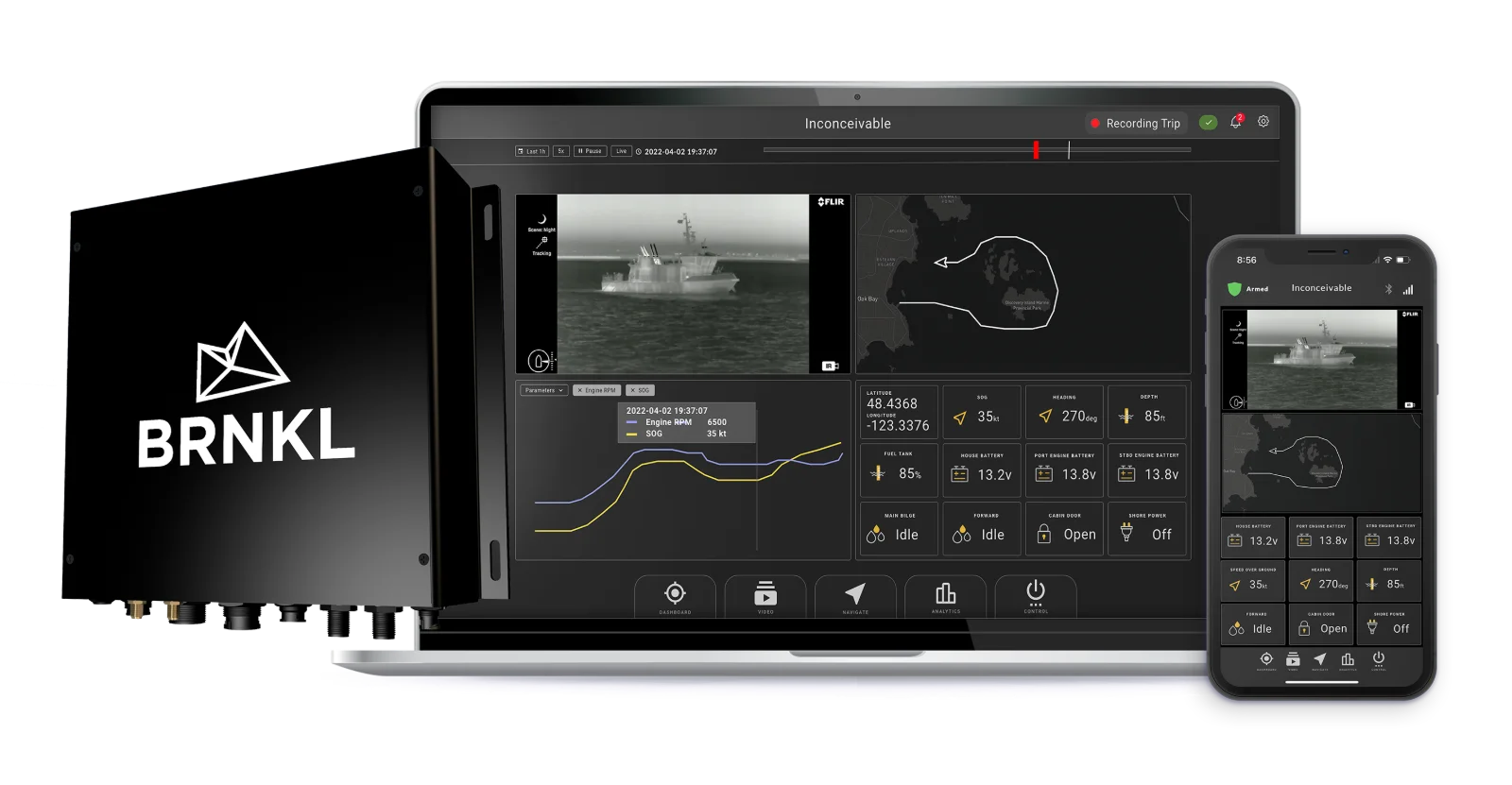
A marine black box is a single onboard recorder that captures everything needed to reconstruct a voyage. It records GPS position, speed and heading, vessel telemetry from the NMEA 2000 network, onboard video where cameras are fitted, impact and motion events, and alerts, and it holds all of it on one synchronised timeline you can play back and share. If a boat is the marine equivalent of an aircraft, the marine black box is its flight recorder.
What a marine black box captures
The value is not in collecting more data. It is in one coordinated record. A capable marine black box captures:
- Position and movement — GPS position, speed and heading throughout the trip
- Vessel telemetry — engine, navigation and alarm data from the NMEA 2000 backbone
- Onboard video — helm, deck, engine bay or cabin views, where cameras are fitted
- Impact and motion — wave slams, shock events and whole-body vibration exposure
- Alerts and events — threshold breaches, system status and operator actions
Because every data point references one shared clock, you can replay a moment and see the video, the position and the engine data together, rather than juggling separate files that never quite line up.
How it differs from a ship VDR
People often confuse a marine black box with a Voyage Data Recorder (VDR). They are not the same thing. A VDR is a regulated SOLAS device fitted to large commercial ships, built to a strict international standard. A marine black box of the kind used on workboats, patrol craft, RIBs and leisure boats is a lighter, more flexible onboard recorder. Its job is practical: incident evidence, trip replay, crew welfare and vessel monitoring, not SOLAS certification.
Who needs one
- Defence and patrol craft that need secure recording and mission playback after an event
- Police, Border Force and enforcement vessels that need accountability and a defensible record
- Commercial workboat and CTV fleets that need an operational evidence trail across the fleet
- Sea safari and passenger RIB operators that need to handle complaints and review incidents
- High-value leisure boat owners who want security, monitoring and proof for insurance
Onboard-first, not cloud-only
A marine black box should record and store data on the vessel first. Cloud upload is a convenience, not the recording requirement. Cellular and satellite coverage are uneven at sea, so the recorder has to keep working when the connection does not. Offline-first recording, with upload as an option when a link is available, is the only model that survives real operating conditions.
Where Mission Dynamics fits
Mission Dynamics supplies marine black box recording and vessel monitoring systems across the UK and Europe:
- BRNKL Black is the marine black box for defence, enforcement and high-tempo commercial operations: secure offline-first recording, synchronised video, GPS vessel tracking and full trip replay.
- BRNKL Blue is a boat monitoring and recording hub for commercial, sea safari and leisure operators, with cameras, NMEA 2000 integration and no subscription.
- Wave Guardian adds a dedicated impact gauge at the helm for live shock and WBV awareness.
Common questions
Is a marine black box the same as a ship VDR? No. A VDR is a regulated SOLAS device for large ships. A marine black box for small craft is a lighter recorder focused on practical evidence, replay and monitoring.
Does a marine black box record video? Where cameras are fitted, yes, time-aligned with GPS and telemetry so everything reviews together on one timeline.
Does it need an internet connection? No. A good system is offline-first, recording on the vessel with upload as an option when available.
Next steps
If you want to understand which configuration fits your vessel and operation, book a short demo with Mission Dynamics, or read our marine black box buying guide for what to specify before you buy.