
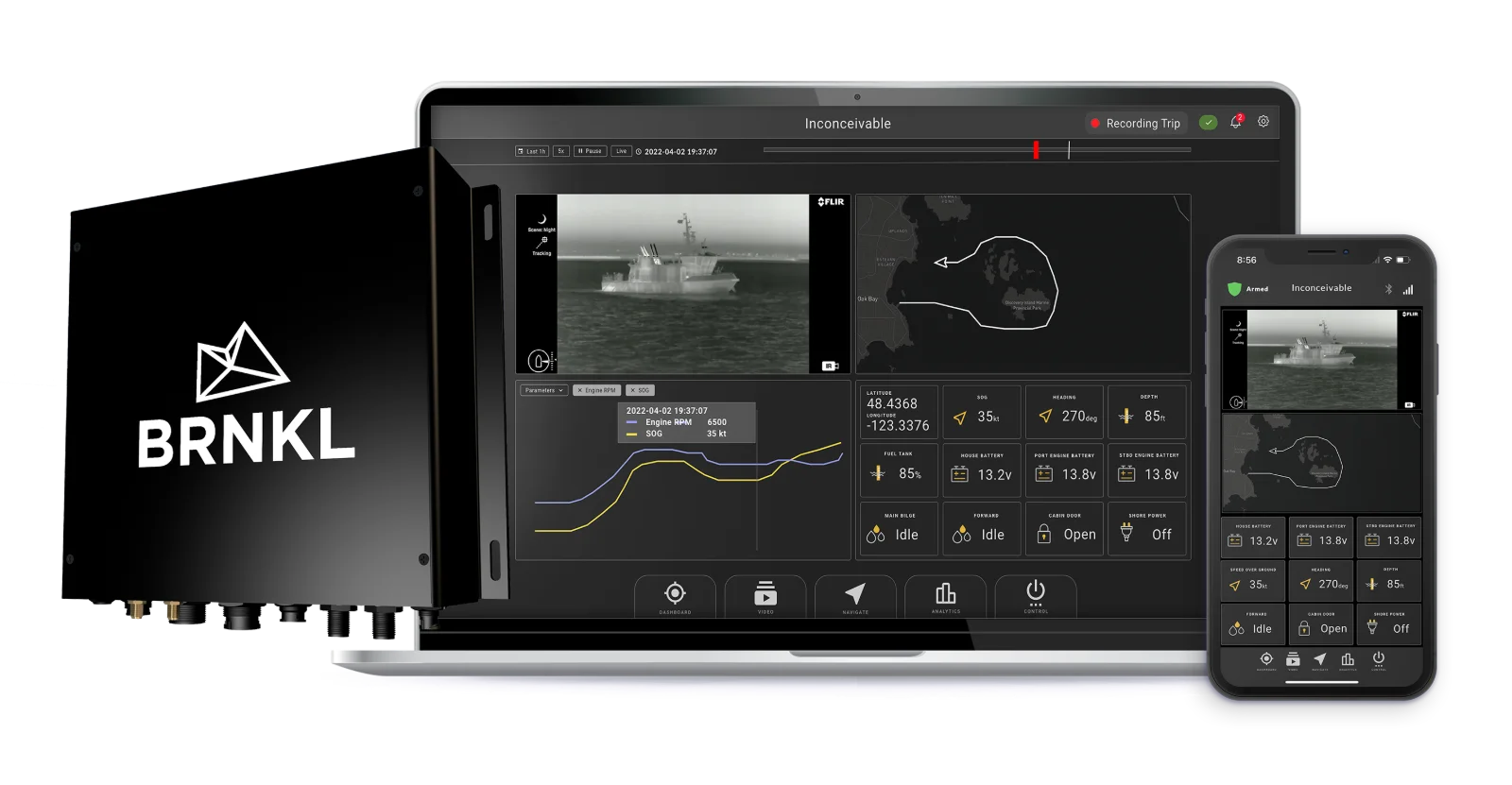
For defence and enforcement craft, "marine black box" is not a marketing phrase. It is a working requirement. When an incident happens at sea, when a deployment needs review, or when a tactical decision is questioned, the operator needs one secure record of what the vessel and crew were doing. This guide sets out what a marine black box for defence and enforcement should actually do, and what to specify before you spend money.
Why fragmented systems fail at the worst moment
Most professional craft already carry monitoring of some kind. The problem is rarely a lack of data. It is fragmentation. Camera systems sit on their own clock. Vessel telemetry comes from a separate logger. Position is held on a chart plotter. Crew biometric inputs, where they exist at all, run on a separate sensor stack.
When something happens, the operator is left assembling the story from devices that do not agree on the time. That gap between systems creates dispute. Dispute creates delay, cost and uncertainty at exactly the moment when clarity matters most.
A marine black box is the discipline of recording every relevant data stream to one shared timeline. Synchronised video. NMEA 2000 vessel telemetry. GPS vessel tracking. Sensor data. Operator inputs. One clock. One record. One source of truth.
The specs that actually matter
Single GPS-locked timeline. Every data point should reference the same clock, locked to GPS time. If devices drift independently, your incident review is guesswork, not investigation.
Onboard-first recording. Defence and enforcement craft operate where connectivity is unreliable or actively suppressed. The recorder must capture and store on the vessel without dependency on cloud or shoreside upload. Connectivity is a transmission convenience, not a recording requirement.
NMEA 2000 integration. Most modern craft already stream engine, navigation and alarm data on the NMEA 2000 backbone. A marine black box that reads this directly captures what the vessel was doing without adding parallel sensors.
Synchronised video. Helm, deck, engine bay and cabin coverage as required by the operation. Video is most valuable when it is locked to the same timeline as vessel telemetry and impact data.
Tactical control over transmission. For tactical operations, GPS vessel tracking should be available when needed and suppressible when not. A physical kill switch over transmitting and receiving components, including GPS, is the practical requirement.
Secure access and export. Data must be retrievable by the people who need it and protected from those who do not. Export should be straightforward enough to support an incident review in hours, not days.
Trip replay across the full dataset. Replay should bring video, position, telemetry, alerts and impact data together on a time-aligned dashboard. This is the single capability that converts raw recording into operational learning.
Operational roles a marine black box supports
- Incident investigation. Reconstruct exactly what happened. What was the vessel doing. What was the crew seeing. What was the sequence of decisions.
- Trip replay and debrief. Use real operational data to develop crew capability instead of relying on memory and self-report.
- Crew impact exposure. Combine vessel acceleration data with optional crew-worn sensors to understand what personnel experienced during high-speed manoeuvres.
- Accountability and oversight. Provide a clear evidence trail for command, for legal review and for partner agencies.
- Maintenance and asset life. Identify high-impact operating conditions and link them to component wear, so inspection cycles match actual exposure rather than calendar dates.
- Mission preparedness. Build operational baselines for routes, sea states and tactical patterns.
What to ask before you sign anything
The right purchase decision is rarely about feature counts. It is about three operational realities:
1. What is your real connectivity environment? If you are on tactical missions or in cellular shadow, an offline-first recorder is the only option that survives contact with reality. Cloud-only systems sound modern in a brochure and fail in the field.
2. What does your incident review actually need? The fastest way to scope a marine black box is to write the incident timeline you would want to produce, then specify the recorder to that. Most operators discover they need less data, better synchronised, with cleaner export.
3. Who else needs to see the record? Partner agencies, insurers, legal teams and command have different access needs. The export and sharing model needs to fit that, not the other way around.
How BRNKL Black is built for defence and enforcement
BRNKL Black is the Mission Dynamics marine black box for defence and enforcement operators. It is designed around the points above: secure onboard recording, single GPS-locked timeline, NMEA 2000 integration, synchronised video, GPS vessel tracking with kill-switch capability, full trip replay and structured export. It is deployed across military craft, police marine units, Border Force and patrol RIB operations across UK and EU waters.
For operators studying crew impact exposure on high-speed craft, BRNKL Black integrates with biometric monitoring including body and head acceleration sensors, supporting the kind of vessel telemetry and crew impact analysis used in NATO MAREC-related study packages.
Next steps
If you are scoping a marine black box for a defence, enforcement or patrol operation, the most useful starting point is a one-page incident timeline you would want to produce after a difficult deployment. Mission Dynamics will then walk through the configuration that delivers it. Request a briefing to start that conversation.
Sources and references
- Maritime and Coastguard Agency: MGN 436 (M+F) Amendment 5. August 2025.
- National Marine Electronics Association: NMEA 2000 standard.
- NATO MAREC: shock exposure measurement programmes for high-speed craft.