
"Get a black box. It will protect you." Most vessel operators have heard the line. Most have also bought systems that promised protection and delivered fragmented recordings, multiple subscriptions and evidence that was useless when it actually mattered. This guide sets out what a marine black box should do, what to specify before you buy and how to avoid the most common mistakes.
What a marine black box actually is
A marine black box is a single onboard recorder that captures the data needed to reconstruct what happened during a voyage. At its useful minimum it records:
- Position, speed and heading from GPS
- Vessel telemetry from the NMEA 2000 network: engine, navigation, alarms
- Onboard video where fitted
- Wave impact and motion events
- Alerts, threshold breaches and system status
The point is not collecting more data. The point is one synchronised record you can play back, share and learn from. That distinction matters because most poor outcomes start with data that sounds comprehensive in a brochure and turns out to be uncoordinated in practice.
Start with the problem, not the product
Before you specify anything, write down what you actually need the recorder for:
- Incident investigation. You need a single synchronised record of video, vessel telemetry and position so an insurer, investigator or operator can reconstruct events without dispute.
- Crew safety and shock exposure. You need live alerts at the helm and an exposure trail you can show afterwards.
- Compliance. You need exposure logs, incident records and a decision trail to evidence the controls in your Safety Management System.
- Operational improvement. You need data that shows what changed when you changed something, route by route and skipper by skipper.
If you cannot describe the use case in one paragraph, you are not ready to choose a product yet.
The specs that actually matter
Single GPS-locked timeline. Every data point must reference one shared clock. If your video clock drifts independently of your telemetry, your incident review is guesswork. Insist on GPS-locked synchronisation across video, telemetry and event data.
Onboard-first recording. The recorder must capture and store data on the vessel. Cloud upload is convenience, not the recording requirement. If the connection fails, the record continues. This is not a niche need. It is the rule, not the exception, in offshore and tactical operations.
NMEA 2000 integration. Your boat already streams engine, navigation and alarm data on the NMEA 2000 backbone. A recorder that reads NMEA 2000 directly explains what the vessel was doing without parallel sensors. Look for native support, not adapter workarounds.
Smart camera strategy. Quality of view beats number of cameras. Decide what you need to see (helm, deck, engine bay, cabin) and choose camera count and placement to match. Recordings tied to vessel telemetry are far more useful than uncoordinated wide-angle coverage.
Realistic connectivity model. Cellular and satellite coverage are uneven. Build the system around offline-first recording, with cellular and satellite as transmission options when available. This is the only model that survives real operating conditions.
Secure access and clean export. Data is only useful if the right people can get to it in the right format. Look for structured export of synchronised video, telemetry and event data, ready for review without manual reconstruction.
Predictable cost. Subscriptions stack quickly across a fleet. Calculate total cost of ownership over three years before you commit. Surprises are usually unwelcome.
The pitfalls to avoid
- Multiple separate systems with separate clocks. The classic combination of standalone camera DVR, separate tracker and disconnected NMEA logger usually produces evidence you cannot defend.
- Cloud-only recording. When connectivity drops, the recording stops. That is the wrong tradeoff for a primary record.
- Subscription creep. Tracking, cameras, SIMs and storage can become several monthly bills. Each has its own portal, each has its own failure mode.
- Camera spray. Eight cameras producing seven hours of low-value footage cost more to store and review than three well-placed cameras that show what matters.
- Brochure-driven specification. Choose against your incident timeline, not against the longest feature list in the room.
How Mission Dynamics maps products to use cases
- Wave Guardian is the dedicated impact gauge at the helm. The right starting point for operators whose first priority is real-time helm guidance and WBV evidence.
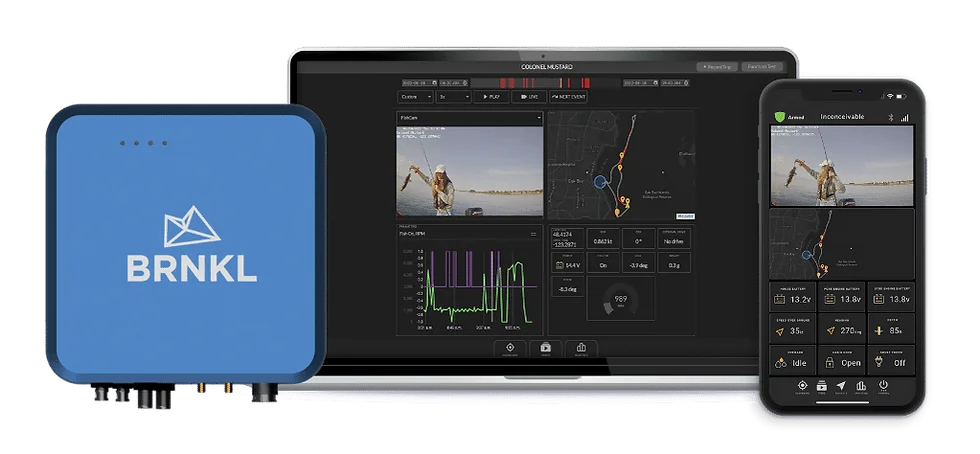
- BRNKL Blue is a boat monitoring and recording hub. Remote oversight, onboard video, NMEA 2000 integration, full trip recording. No subscription overhead. Suits commercial, sea safari and leisure operators.
- BRNKL Black is the marine black box for defence, enforcement and high-tempo commercial operations. Secure onboard recording, synchronised video, GPS vessel tracking with kill-switch capability and full trip replay for incident investigation.
The one practical step that pays off
Before you talk to any vendor, write a one-page specification covering four things:
- What you are trying to solve
- What data you actually need to capture
- How you will access the data in the field
- How you will export and share it
You will buy faster. You will waste less. You will end up with a recorder you actually use.
Next steps
If you want to walk through your specification and which configuration fits, book a short demo with Mission Dynamics.
Sources and references
- National Marine Electronics Association: NMEA 2000 standard.
- MCA: MGN 436 (M+F) Amendment 5: Whole body vibration. Maritime and Coastguard Agency, August 2025.
- MCA: Workboat Code Edition 3.