
Whole-body vibration (WBV) is the repeated shock crews absorb when a fast craft works in waves, and MGN 436 is the UK guidance on managing it. If you run high-speed workboats, patrol RIBs, pilot boats or sea safari craft, this is the short version of what WBV is, what MGN 436 Amendment 5 expects, and how to monitor shock exposure in practice.
What whole-body vibration is
WBV is the vibration and shock transmitted to the body through the deck, seat or feet. On planing craft it comes mainly from repeated wave impacts: each slam sends a jolt through the hull and into the crew. A single impact is rarely the problem. The damage is cumulative. Over a shift, a season or a career, repeated exposure is linked to fatigue, reduced concentration, and back and joint injury.
What MGN 436 is
MGN 436 is a Marine Guidance Note from the UK Maritime and Coastguard Agency (MCA) covering the risk of whole-body vibration, severe shocks and repeated impacts on small commercial vessels. Amendment 5, issued in 2025, reflects current best practice, including the role of shock-mitigating technology and operational data in managing exposure. It sits alongside the operator's wider duty of care under health and safety law.
MGN 436 is guidance, not a single numeric pass or fail for every vessel. It expects operators to understand the exposure their crews face and to put sensible controls in place: training, route and speed decisions, seating and posture, and suitable technology.
Workboat Code Edition 3
Workboat Code Edition 3 comes into effect in December 2026 and strengthens expectations around crew welfare and shock exposure on commercial craft. Operators are increasingly expected to show how they identify repeated-impact risk and what they do about it, not just to assert that conditions felt acceptable on the day.
How to monitor shock and WBV exposure
Monitoring WBV comes down to making the invisible visible. There are two complementary layers:
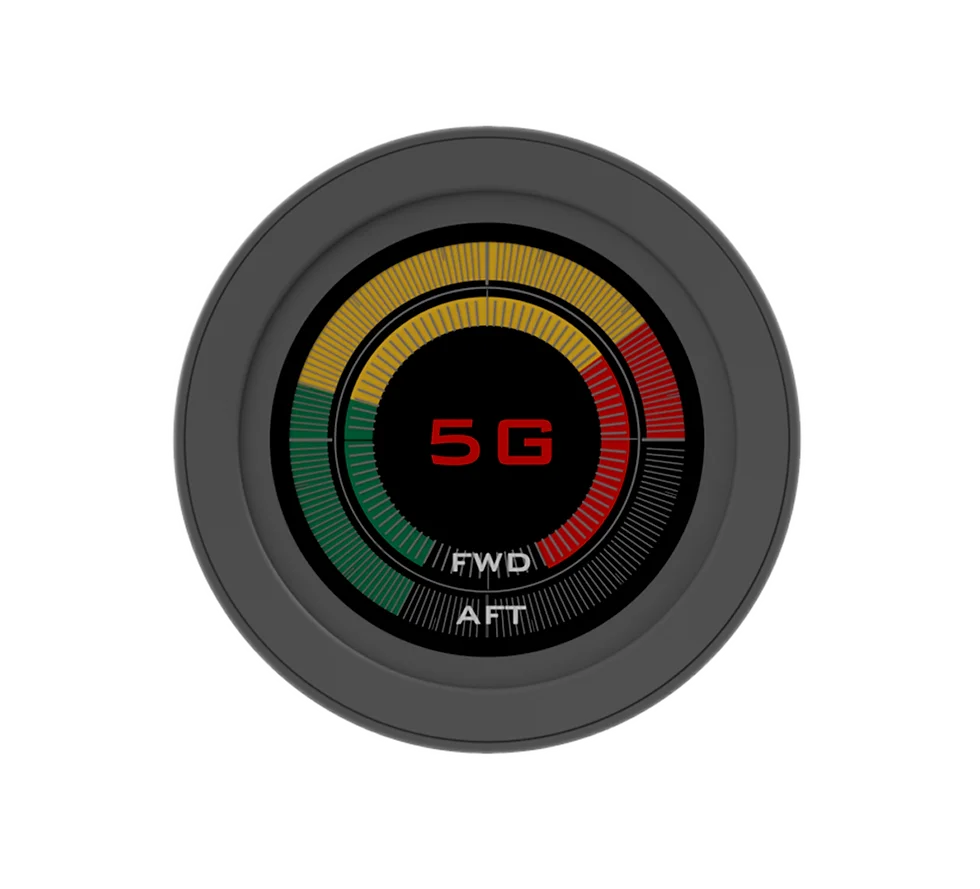
- Real-time helm awareness. A dedicated impact gauge at the helm shows the crew, while they are still driving, when impacts are building. That is the moment a decision can be made: ease the throttle, change heading, pick a better line through the sea. Wave Guardian is built for exactly this: an always-on gauge that keeps wave impact and WBV awareness in direct view.
- Recorded exposure trail. Logging impacts and motion over time gives you something to review after the trip, for crew welfare conversations, incident investigation and to evidence the controls in your Safety Management System. A marine black box captures this alongside video and vessel telemetry.
What monitoring does not do
WBV monitoring supports judgement; it does not replace it. A gauge reading or an exposure log is not a vessel-specific safety standard on its own. The operator remains responsible for the risk assessment, training, procedures and the thresholds chosen for the vessel, route and operating profile. The value of monitoring is that it turns "it felt fine" into an evidence-led conversation.
A practical first step
For most operators, the simplest move from MGN 436 wording to visible control is fitting a helm-facing impact gauge. It is low-cost, quick to install and immediately changes the conversation at the helm. From there, operators who need recorded evidence and trip replay add a marine black box.
Where Mission Dynamics fits
- Wave Guardian — the dedicated WBV and impact gauge at the helm for real-time awareness.
- BRNKL Black — marine black box recording for exposure logging, trip replay and incident investigation.
- BRNKL Blue — monitoring and recording hub for commercial and sea safari fleets.
Next steps
To talk through WBV monitoring for your vessel type and duty profile, book a short demo, or read our guide to preparing for Workboat Code 3 and MGN 436 Amendment 5.
Sources and references
- MCA: MGN 436 (M+F) Amendment 5: Whole body vibration. Maritime and Coastguard Agency, 2025.
- MCA: Workboat Code Edition 3.