
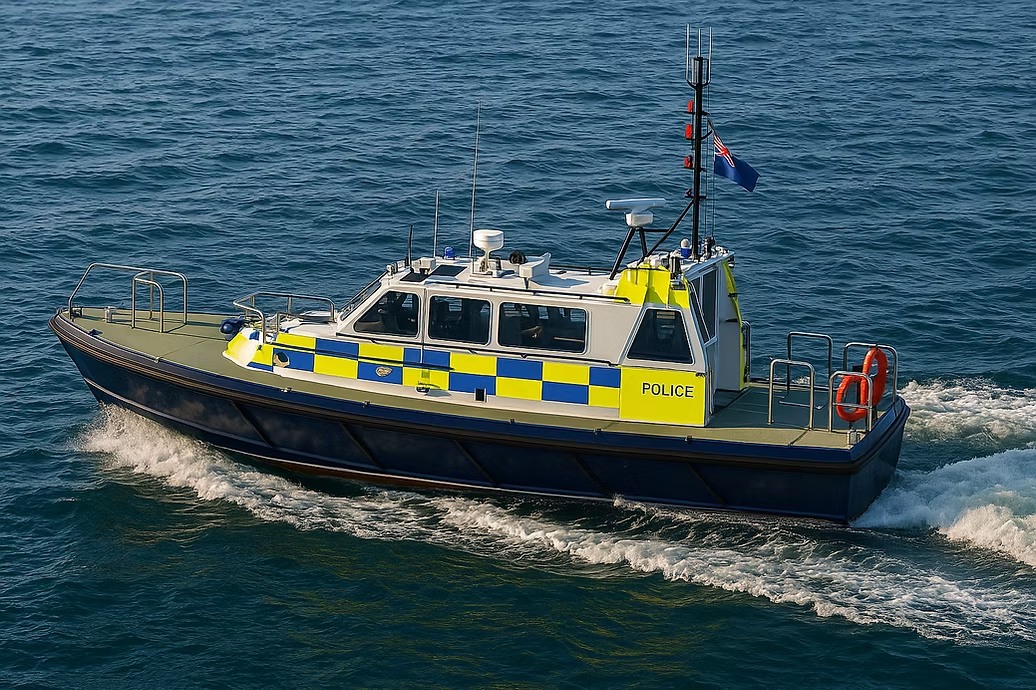
Workboat Code Edition 3 has been in force since 13 December 2023, and the first major transition deadline lands on 13 December 2026. If you operate commercial workboats, pilot boats or high-speed craft in UK waters, the practical question is not whether the code applies. It is what you need to do to be ready, what MGN 436 Amendment 5 changes in day-to-day operations, and what evidence will hold up when a surveyor, an insurer or an investigator asks.
What Workboat Code Edition 3 actually changes
Workboat Code Edition 3 sits under the Merchant Shipping (Small Workboats and Pilot Boats) Regulations 2023 (SI 2023/1216). It consolidates earlier frameworks that operators previously had to navigate separately, including the Brown Code from 1998, its equivalent technical annex in MGN 280(M) and Workboat Code Edition 2 Amendment 1.
For an existing vessel certificated under any of those previous codes, the transition deadline is the next renewal examination or 13 December 2026, whichever is later. In February 2026 the Maritime and Coastguard Agency and the Workboat Association issued a joint message urging operators to act early: check the code, prepare the vessel and book the survey. The risk they flagged is a shortage of certification slots in the run-up to December, leaving vessels tied up while they wait.
Edition 3 also moves the industry from prescriptive equipment lists towards a risk-based approach. Annex 8 introduces a mandatory Safety Management System (SMS) for every vessel covered by the code, regardless of size or duty. The code also brings in the first UK maritime safety legislation for remotely operated unmanned vessels and workboats using alternative fuels.
How MGN 436 Amendment 5 fits in
MGN 436 (M+F) Amendment 5 was published by the MCA in August 2025 and replaces Amendment 4. It is guidance on mitigating the effects of shocks, impacts and whole-body vibration (WBV) on small vessels. The guidance is primarily focused on high-speed craft, because that is where most repeated-shock injuries are seen.
MGN 436 sits alongside two other documents that operators need to be aware of:
- MGN 353 (M+F) Amendment 2. The Merchant Shipping and Fishing Vessels (Control of Vibration at Work) Regulations 2007. This sets the exposure action value (EAV) and exposure limit value (ELV) for vibration exposure.
- MGN 636 (M) Amendment 4. The Merchant Shipping and Fishing Vessels (Health and Safety at Work) Regulations 1997.
Together, these documents make WBV and repeated shock a managed operational risk on fast craft, not a comfort issue. Earlier studies on craft under 24 metres found that real exposure was often well above the ELV in minutes, not hours. That is why MGN 436 Amendment 5 reflects evolving best practice including the use of shock-mitigating technology and operational data.
What surveyors, insurers and clients will look for
Edition 3 and MGN 436 together change what "good" looks like in audit and tender. Expect questions about:
- A documented Safety Management System aligned with Annex 8
- A route and vessel specific risk assessment, not a generic template
- Clear trigger points for changing speed or heading as sea conditions build
- Evidence that crews and passengers are briefed on posture, bracing and conduct
- A review process that captures high-impact events and shows what changed afterwards
- An audit trail you can produce at renewal, at tender stage or after an incident
The pattern the regulator and industry bodies want to see is a controlled loop: prevent, monitor, review.
A three-layer compliance approach that works
Layer 1: Prevent. Set route and speed guidance matched to your vessel type and duty cycle. Define simple trigger points for slowing down or changing heading. Brief crew and passengers before departure, including seating, posture and bracing. Make briefings consistent and recorded.
Layer 2: Monitor. Use a wave impact and WBV monitor at the helm so the coxswain has live feedback during the trip. Record each voyage so high events can be reviewed later with full context: time, position, speed, heading and sea state. Without that record, post-incident review is reconstruction from memory.
Layer 3: Review. Build a short after-action review into the working week. Look at the worst events. Identify the route, conditions or technique that produced them. Change one variable and check whether severity drops on the next run. That is what proves your controls work.
Why monitoring matters at audit and after an incident
Two events in 2025 made the case for objective ride data clearer. The first is the publication of MGN 436 Amendment 5 itself, which makes shock-mitigating technology and data part of recognised best practice. The second is the MAIB Lundy Explorer report, published in August 2025. The MAIB recommended that the operator install vibration and shock sensors on its RIBs, allowing skippers to monitor and mitigate passenger exposure to dangerous forces. That recommendation signals where investigator and certifier expectations are heading.
If you operate fast craft, the same expectation is likely to come from your insurer, your client and your certifying authority within the current regulatory cycle.
How Mission Dynamics maps to the three layers
- Wave Guardian provides the always-on impact gauge at the helm with crew overexposure alerts and real-time helm guidance. It is the simplest first step from compliance wording to visible control.
- BRNKL Blue adds remote boat monitoring, onboard video, NMEA 2000 integration and full trip recording for post-trip review and incident evidence.
- BRNKL Black is the marine black box for defence, enforcement and high-tempo commercial operations where secure recording, GPS vessel tracking and incident investigation are critical.
One step you can take next week
Pick one route. Agree a single "red event" threshold with the crew. Make the post-trip review a ten-minute habit. Then start building the audit trail before the survey, not after it. That is how operators turn the December 2026 deadline from a problem into a strengthened position with clients and surveyors.
If you want a short conversation about how to fit Wave Guardian or BRNKL into your operation ahead of the deadline, book a demo with Mission Dynamics.
Sources and references
- MCA: MGN 436 (M+F) Amendment 5: Whole body vibration. Guidance on mitigating against the effects of shocks and impacts on small vessels. Maritime and Coastguard Agency, August 2025.
- MCA: MGN 353 (M+F) Amendment 2. The Merchant Shipping and Fishing Vessels (Control of Vibration at Work) Regulations 2007.
- MCA: Workboat Code Edition 3. Maritime and Coastguard Agency. SI 2023/1216.
- MCA and Workboat Association joint press release, "United message for Workboat Code Edition 3 deadline: Check. Prepare. Book", GOV.UK, February 2026.
- MAIB: Report on the investigation of a serious injury to a passenger on the sea safari rigid inflatable boat Lundy Explorer at Ilfracombe, England on 7 June 2023. Marine Accident Investigation Branch, August 2025.