
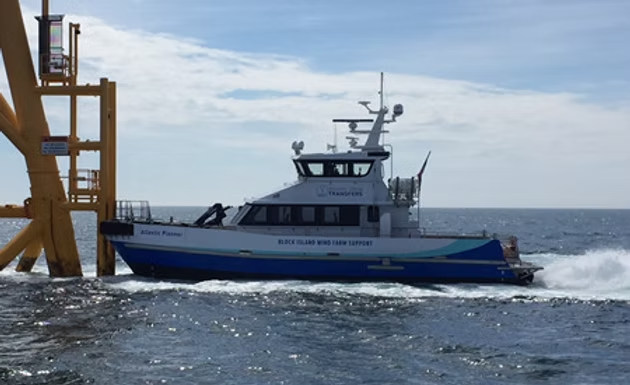
Crew transfer vessels live with a particular pattern of pain: short, high-frequency runs, often in marginal sea states, with strong pressure to keep the schedule. That pattern is what drives whole body vibration exposure, crew fatigue, technician injury risk and accelerated vessel wear. Managing it well is a commercial issue and a safety issue at the same time.
Why CTV operations are an outlier for shock exposure
Most workboat exposure is measured by duty cycle and conditions. A CTV is an outlier on both. Multiple transits a day. Repeated boat landings on a turbine. Long shifts. Skippers under live commercial pressure to deliver technicians on time and ready to work. That combination makes WBV exposure stack up faster than most onshore risk assessments would predict.
The Health and Safety Executive's adoption of the Control of Vibration at Work Regulations 2007, applied to maritime through MGN 353 (M+F) Amendment 2, sets the exposure action value (EAV) and exposure limit value (ELV) framework. On small fast craft, real exposure can exceed the ELV in minutes rather than hours. Crews working a full shift can be deep into accumulated exposure long before the day ends.
The cost is not only safety
Operators sometimes treat WBV as a crew welfare issue and stop there. The wider commercial picture matters too.
- Crew fatigue. Tired technicians and skippers make slower, less accurate decisions. Productivity at the turbine drops before anyone calls it fatigue.
- Injury risk. Lower back, neck and shoulder injuries are the most common WBV-related claims in the sector. Each one has a direct cost in cover, replacement and potential litigation.
- Vessel wear. Repeated severe impacts shorten the service life of hulls, fendering, drives and onboard equipment. Maintenance budgets quietly bleed through the year.
- Charter rates and tender position. Wind farm operators and tier-one contractors increasingly ask CTV operators to evidence WBV controls. A monitored fleet is easier to win work with.
From "we know it's rough" to managed exposure
Most CTV skippers can tell you when a transit was rough. What is usually missing is an objective, comparable record. Three practical capabilities convert intuition into managed exposure:
1. Live impact feedback at the helm. An always-on vessel shock monitor gives the skipper a visual cue when the ride is escalating, while there is still time to ease speed or change heading. That is the difference between mitigating exposure and recording it after the fact.
2. Per-transit recording. Every transit logged with time, position, speed, impact events and onboard video where fitted. This is what lets you compare like-for-like across routes, skippers and conditions.
3. Short, regular review. A weekly look at the worst events. Identify the route, conditions or technique that produced them. Change one variable. Track the result. This is the loop that turns exposure data into reduced exposure.
Linking ride data to maintenance windows
The same data that protects crews protects the vessel. Repeated heavy slams are the leading cause of premature wear on fast CTV hulls and drives. Linking impact severity to specific transits and components lets the operator plan inspections by actual exposure, not by calendar.
Operators using this approach typically see two effects. Unplanned downtime falls because issues are identified before they become failures. Maintenance spend redirects from emergency repair to scheduled inspection. Both improve fleet availability for the wind farm client.
A practical CTV monitoring setup
For most CTV operators the minimum viable monitoring stack is:
- Wave Guardian at the helm. Always-on impact gauge, crew overexposure alerts, real-time helm guidance. No subscription.
- BRNKL Blue as the data and video hub. Trip recording with synchronised onboard video, NMEA 2000 integration, GPS vessel tracking and remote oversight from shore.
- A short weekly review process with skippers. Use the recorded transits to coach for outcomes: fewer severe events per hour, not "slow down".
This setup is typically faster to install than operators expect and avoids subscription overhead that scales painfully across a fleet.
Aligning with MGN 436 and Workboat Code 3
MGN 436 Amendment 5 makes shock-mitigating technology and operational data part of recognised best practice on high-speed craft. Workboat Code Edition 3 requires every CTV to operate under a Safety Management System per Annex 8, with the December 2026 transition deadline approaching for vessels still on previous codes. Monitored, recorded and reviewed transits are the strongest evidence an operator can present at survey, at tender stage and after an incident.
Next steps
If you operate CTVs in UK or EU waters and want to move from "we know it's rough" to a managed, evidenced approach to WBV and asset life, book a short demo with Mission Dynamics. We will walk through your routes, duty cycle and current data picture and recommend the simplest practical setup.
Sources and references
- MCA: MGN 436 (M+F) Amendment 5: Whole body vibration. Maritime and Coastguard Agency, August 2025.
- MCA: MGN 353 (M+F) Amendment 2. Control of Vibration at Work Regulations 2007.
- MCA: Workboat Code Edition 3. Maritime and Coastguard Agency, in force 13 December 2023, transition deadline 13 December 2026.
- HSE: Control of Vibration at Work Regulations 2005 (parent UK regulation).