
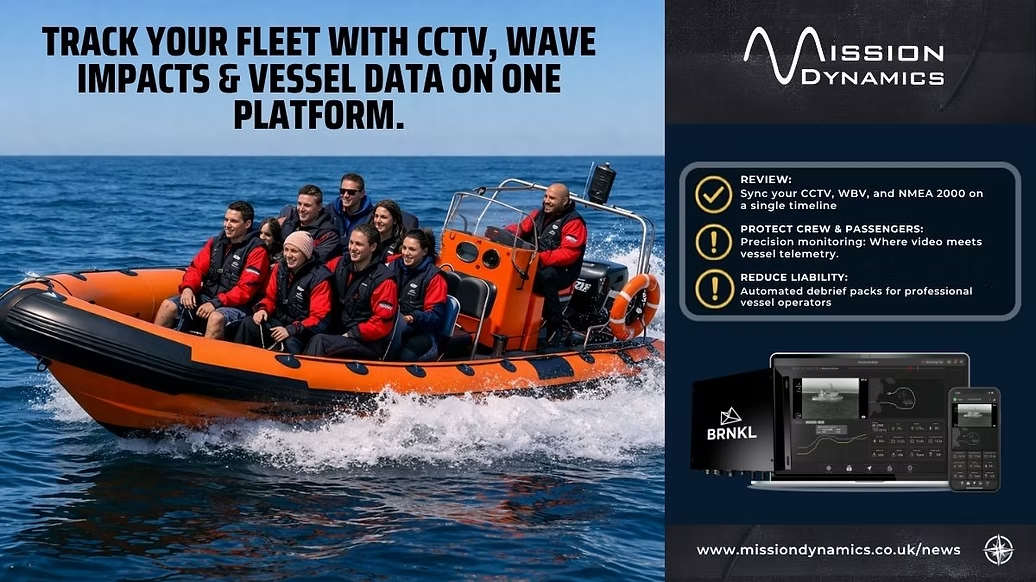
The MAIB published its Lundy Explorer report in August 2025. For sea safari and passenger RIB operators it is the clearest signal yet about what good duty of care looks like. The report sets out the failures, the wider pattern of similar injuries and the practical steps every operator can take now to manage shock exposure and protect passengers.
What happened on Lundy Explorer
On 7 June 2023 the rigid inflatable boat Lundy Explorer departed Ilfracombe Harbour on a sea safari trip. Local conditions had deteriorated more quickly than the skipper expected, producing choppy seas and higher waves. While still below planing speed at about 7 knots over the ground, the RIB encountered two high waves. After a third wave the bow landed on the water with force and the boat came to a sudden stop.
A 28-year-old passenger in a port-side jockey seat at the front of the RIB was dislodged and fell to the port side. The shearing force fractured her T12 vertebra and damaged her spinal cord, resulting in permanent paralysis. The other two passengers in jockey seats were not seriously injured.
What the MAIB found
The MAIB investigation identified four contributing factors:
- Local weather conditions deteriorated quickly, producing higher and choppier waves than the skipper had expected.
- The forward jockey seats were unsuitable for single occupancy. They exposed passengers to high shock loads when the boat slammed into waves.
- The pre-departure safety briefing did not include adequate instruction on the use of the seats, so passengers were unaware of the specific risks.
- Current regulations do not reference safety standards for the design, position and use of seats on high-speed RIBs.
The Chief Inspector of Marine Accidents, Andrew Moll OBE, was clear that the Lundy Explorer case is not an isolated incident. The MAIB has been notified of 54 accidents during RIB rides resulting in lower back injuries since 2001, of which 17 caused spinal fractures. Earlier MAIB investigations including the Seadogz report (MAIB Report 10/2023) had already flagged the same pattern.
The recommendation operators should pay closest attention to
The MAIB made formal recommendations to the MCA, to Ilfracombe Sea Safari Limited and to industry bodies including the Royal Yachting Association, British Marine and the Professional Charter Association.
One of the recommendations to the operator stands out for the wider sector. The MAIB recommended that the operator install vibration and shock sensors on all its RIBs, allowing skippers to monitor and mitigate passenger exposure to dangerous forces.
That recommendation is significant. It places vessel shock monitoring directly inside the safety controls a sea safari operator is expected to consider. It also reflects what MAIB Safety Bulletin SB3/2023 already urged in advance of the full report: operators of small commercial passenger vessels need to review their operations, briefings and procedures in line with current safety guidance.
Six steps every sea safari operator should take now
Whether your fleet is one RIB or twenty, the following steps reflect the direction the MAIB, the MCA and industry bodies are travelling in.
1. Review seating positions on every vessel. Pay particular attention to forward jockey seats, especially when used for single occupancy. The forward area of any planing RIB carries the highest shock loads in a wave impact.
2. Make safety briefings consistent and recorded. Cover seat use, posture, bracing and what to do if a passenger feels unsafe. A documented briefing process is part of a credible Safety Management System under Workboat Code Edition 3.
3. Build a route and condition specific risk assessment. Generic templates will not stand up. Reflect the actual sea state ranges, route hazards and operational triggers for your patch.
4. Add objective ride data. Install vessel shock monitoring so the skipper has live impact feedback at the helm and you have an evidence trail you can review after the trip. This is the step the MAIB has now explicitly recommended.
5. Establish a short post-trip review. Look at the worst events. Identify the route, conditions or technique that produced them. Change one variable and check whether severity drops on the next run. That is what proves your controls work.
6. Strengthen your evidence pack for incidents. Time-synced position, speed, shock events and onboard video form a single timeline that an insurer, investigator or family can rely on.
Why "I felt it was acceptable" is no longer enough
The Lundy Explorer skipper was operating slowly in a harbour area. Skipper judgement was reasonable. The injury still occurred. That is the central lesson for the sector. Safety on commercial RIB rides is now judged on the systems and evidence behind a trip, not only the moment of decision at the helm.
If a passenger is injured on your boat, the questions that follow will be about what controls you had in place, what you briefed, what you monitored and what you can show. A skipper account from memory is no longer the strongest evidence available.
How Mission Dynamics helps sea safari operators
Mission Dynamics works with sea safari and passenger RIB operators across UK and EU waters. The most common starting point is Wave Guardian, an always-on helm gauge for wave impact monitoring and crew or passenger overexposure alerts. It directly addresses the MAIB's recommendation around live shock awareness for the skipper.
For operators who also want onboard video, NMEA 2000 data, full trip recording and remote oversight from shore, BRNKL Blue adds the evidence layer behind the helm gauge. Together they give you a defensible position at survey, at tender and after an incident.
If you want to walk through your operation and the most practical first step, book a short demo with Mission Dynamics.
Sources and references
- MAIB: Report on the investigation of a serious injury to a passenger on the sea safari rigid inflatable boat Lundy Explorer at Ilfracombe, England on 7 June 2023. Marine Accident Investigation Branch, published 21 August 2025.
- MAIB: Safety Bulletin SB3/2023. Marine Accident Investigation Branch, 2023.
- MAIB: Report 10/2023, Seadogz. Marine Accident Investigation Branch.
- MCA: MGN 436 (M+F) Amendment 5: Whole body vibration. Maritime and Coastguard Agency, August 2025.
- MCA: Workboat Code Edition 3. Maritime and Coastguard Agency.